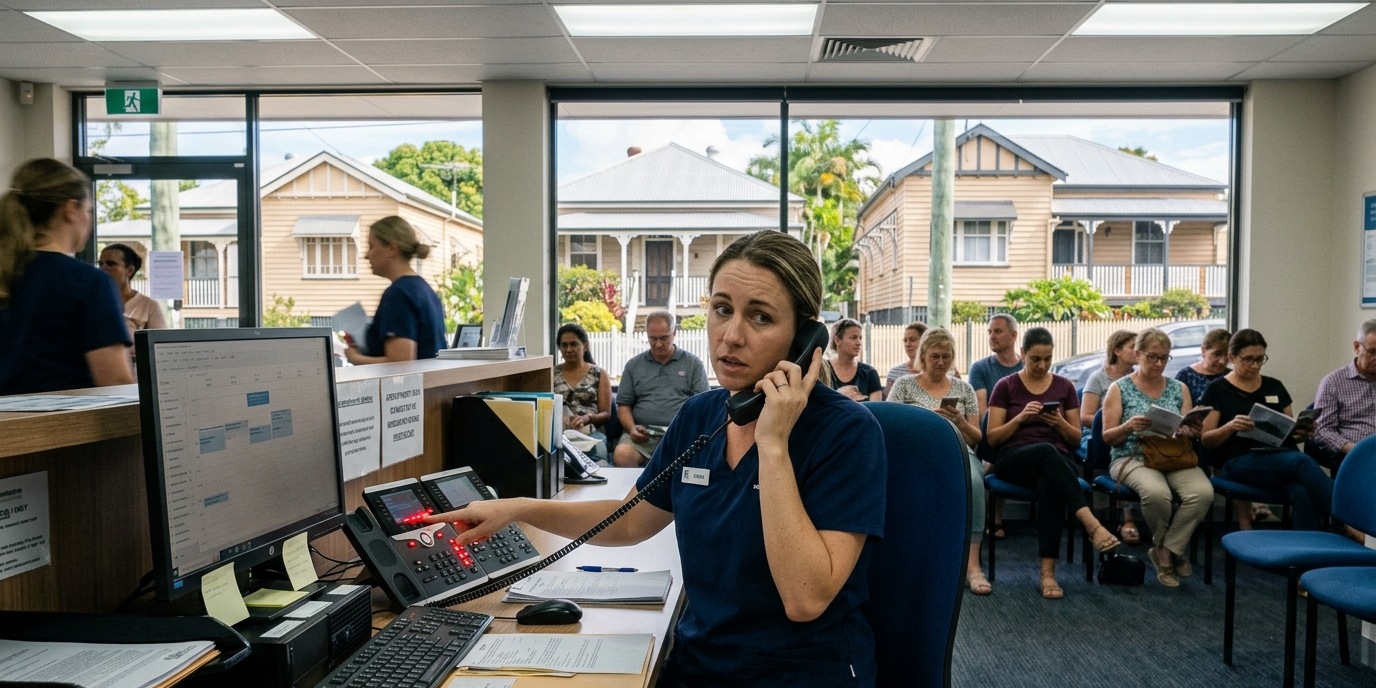
Australian GP clinics experience a predictable 9am call spike where 62% of all daily inbound volume arrives in the first 90 minutes of opening. The root cause is appointment scarcity combined with a fixed opening time — patients who couldn't get through the day before all call simultaneously. The operational fix is AI-assisted call handling that answers every call instantly regardless of queue depth, triages urgency, and books into the right appointment slots automatically, without increasing reception headcount.
What's actually happening at 9am
In our benchmark of 47 Australian GP and specialist practices, the 9am spike is universal and predictable. Between 8:58am and 10:30am, the average practice receives 61% of its entire day's inbound call volume. The causes stack: patients who tried to get through yesterday and couldn't; patients who woke up with a new concern; carers coordinating appointments before the working day starts; and patients responding to recall SMS messages that practices often send in the evening.
The result is a queue that a two or three person reception team simply cannot clear at the speed it arrives. Hold times hit 8–12 minutes. Patients hang up. Some call back. Some don't. Some book with a different practice. And the reception team, who are often also managing check-ins, handling pathology results, and processing scripts, start the day already behind.
Why hiring more receptionists doesn't fix it
The obvious solution — hire another receptionist — has two problems. First, the cost: a full-time receptionist in Sydney or Melbourne costs $55,000–$70,000/year in salary plus oncosts. For a small practice with thin margins, that's a significant commitment. Second, the pattern: the spike lasts 90 minutes, then call volume drops sharply. You're hiring a full-time employee to solve a 90-minute daily problem, and that employee will be underutilised for the remaining six and a half hours of the day.
Part-time solutions don't map cleanly to the spike pattern either, because the spike starts at exactly opening time — the hardest time to staff with a part-time employee who might not arrive until 9:30.
The AI-assisted model that's working
The practices in our benchmark that have solved the 9am problem haven't done it by adding headcount — they've done it by having an AI handle the calls that don't require a human receptionist. That's roughly 70% of morning calls: appointment bookings, appointment changes, repeat script requests, results inquiries with routine outcomes, and recall booking.
With AI handling those calls simultaneously (no queue, answered in under a second), the human reception team can focus on the 30% that genuinely need them: complex queries, distressed patients, clinical triage that requires judgement, and the front desk work that can't be done over the phone at all.
The practices that have implemented this approach report that reception staff describe their 9am as "manageable" for the first time, with significantly reduced stress and substantially lower staff turnover. That second-order benefit — retention — is often the one practice managers hadn't predicted but value the most.
The clinical safety piece
The legitimate concern with AI call handling in a medical setting is clinical safety — specifically, whether the AI can correctly identify urgent calls and escalate appropriately. This is the right question to ask, and the answer depends entirely on the system's configuration.
CallSorted's medical triage is configured with explicit red-flag symptom detection: chest pain, difficulty breathing, signs of stroke, severe bleeding, altered consciousness. Any call containing these presentations is immediately escalated to the triage nurse on duty, with zero delay. The AI does not attempt to manage these calls — it flags and transfers, with a summary for the clinician receiving the transfer.
For routine calls, the AI uses the practice's appointment logic: same-day slots are reserved for acute presentations; standard slots for routine bookings; telehealth options where appropriate. The system integrates with all major Australian GP practice software, so bookings appear in the clinical schedule in real time.
Is AI call handling compliant with Australian health privacy law?
Yes. CallSorted is compliant with the Australian Privacy Act 1988 and the Australian Privacy Principles. All data for Australian customers is stored on Australian servers. Recordings are retained per your practice's data retention policy and are deletable on patient request. We do not use patient data for AI training.
How does it handle callers requesting specific doctors?
The AI knows your practitioners and their availability. Callers can request a specific GP and the system will book into that GP's next available slot, offer alternatives if the preferred GP is unavailable, or place the caller on a waitlist if that's your practice's preference.
What about patients who don't want to deal with AI?
Callers who prefer to speak with a human can say so at any point, and the call transfers immediately. In practice, fewer patients than practices expect have this preference — most callers want their question answered quickly, and the AI does that faster than a queued human receptionist.
Can it handle bulk-billing vs private billing queries?
Yes. The AI knows your billing model — fully bulk-billed, mixed billing, private only — and handles billing queries accurately. For mixed-billing practices, it can apply your billing logic based on patient type, appointment type, and practitioner.
Book a demo to see how CallSorted handles a live medical call — including triage, Medicare verification, and clinical software integration.