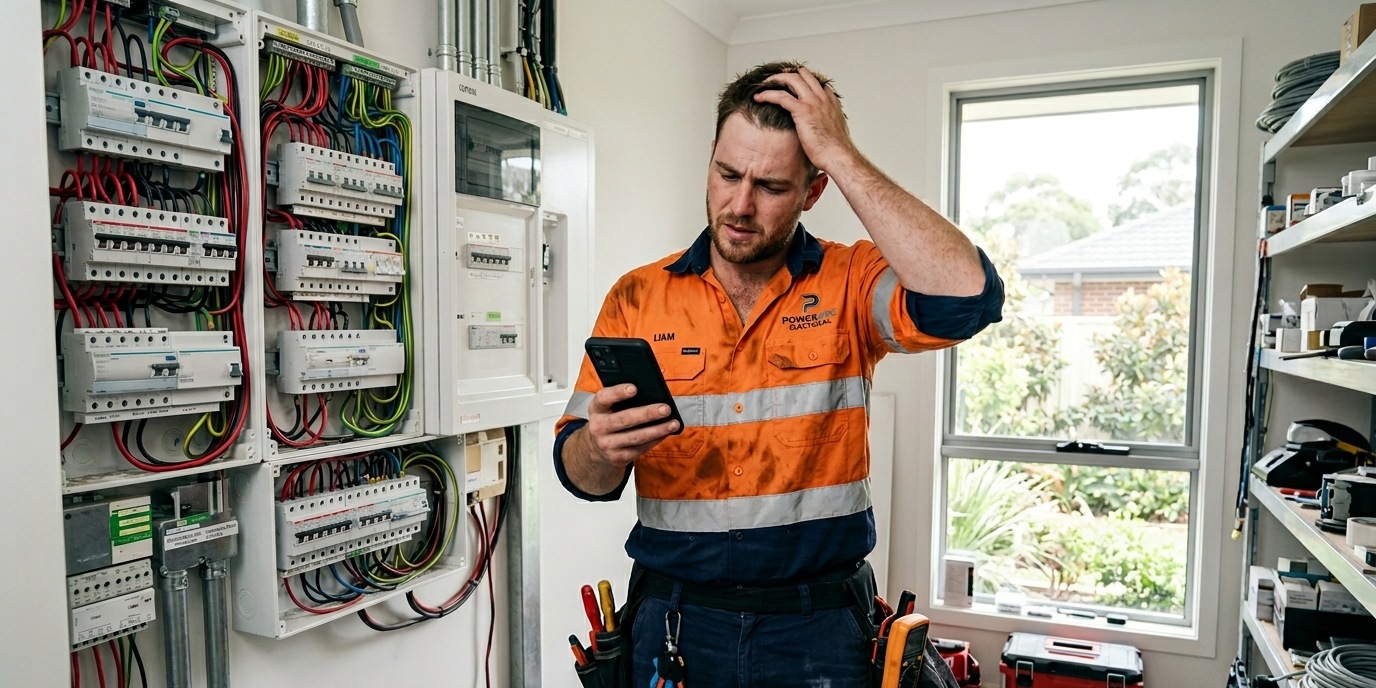
Most Australian electrical businesses plateau at $500K–$800K annual revenue. The primary constraint isn't technical capacity or work availability — it's the owner's inability to answer the phone while working. At 3+ employees, an electrical business needs dedicated call handling to break through the $1M revenue barrier. AI call handling removes the phone as the growth bottleneck without adding overhead.
You started as a sparky. You were good at the work, so you took on an apprentice. Then another. Now you're running a 4-person team, turning over $620K, and working harder than you ever have — but the revenue won't seem to go past $700K no matter what you do.
The ceiling isn't the work. It's the phone.
How the phone becomes the growth bottleneck
In a 1-man electrical business, you answer your own phone and it mostly works. At 3–4 people, you're in the field alongside your team. The phone rings while you're in a switchboard, on a roof, or mid-quote with a client. You miss calls. Some of those calls are jobs worth $4,000–$15,000 that go to the electrician who happened to answer.
The owner of a $620K electrical business is typically the best salesperson, estimator, project manager, and quality controller in the company — and they're missing 3–6 calls per day because they're also on the tools. That's a structural problem that hiring more sparkies doesn't solve.
What breaks the ceiling
Breaking $1M in electrical requires either: (a) a dedicated office admin/receptionist — adding $55K–$70K in overhead — or (b) AI call handling that captures every lead without adding headcount. Most electrical businesses growing through the $700K–$1M range choose option (b) because the math is clear.
An AI receptionist at $400/month captures 6 additional calls per day at average job values of $2,800. If even 2 of those 6 daily calls convert to jobs, that's $5,600 per day in recoverable revenue. The payback period on AI call handling for an electrical business hitting the ceiling is typically 11 days.
Frequently asked questions
At what revenue point does an electrical business need dedicated call handling?
The tipping point is typically when the business reaches 3 full-time field staff and the owner is consistently on-site rather than office-based. This usually corresponds to $450K–$550K annual revenue. Before this point, the owner can realistically manage calls between jobs. After it, they're generating too much field supervision and quoting activity to reliably answer — and missing calls is actively capping revenue.
How does AI handle the technical nature of electrical enquiries?
Most inbound electrical calls are not highly technical — they're booking requests, quote requests, or urgent callout requests. "I need a safety switch installed," "my lights are flickering," "I need a quote for a new circuit" — these are handled perfectly by AI. Highly technical specifications (engineering consulting, complex commercial design) are flagged for callback from the estimator. The AI's job is to capture the lead, not to provide technical advice.
Can AI handle after-hours emergency electrical calls appropriately?
Yes. CallSorted's electrical configuration handles after-hours calls with a triage layer — distinguishing between genuine emergencies (power out, electrical smell, safety hazard) that trigger immediate on-call notification, and routine after-hours enquiries (next-day booking requests, quote requests) that are logged for morning followup. Emergency callouts at 11pm are worth $800–$2,000+ and warrant an on-call response; routine enquiries don't need to interrupt anyone's sleep.
Ready to break through the revenue ceiling? Book a demo — we'll show you the numbers for your specific business size.